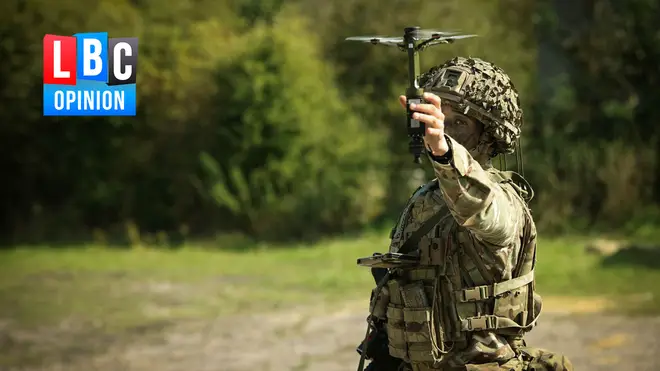
Back in 2022, Ukrainian field regulations still said artillery fire correction from the air should be carried out by helicopter.
Read that now and it feels like something from another age. On today’s front line, drones watch, spot, correct fire, hunt armour, strike positions, map routes and shape movement every hour of the day.
They are not a supporting feature of modern war. They are one of its defining conditions.
Spend any real time looking at how this war is being fought and the pattern becomes impossible to ignore. The defining change is the size of the kill zone. In earlier phases of war, danger was often shaped by artillery range and direct contact over a far shorter distance.
Now, on some parts of the front, that zone can extend to nearly 30 kilometres because drones are constantly searching, identifying movement and feeding strikes into the system. Once you enter that space, survival drops sharply. That is why Russian forces can lose thousands of men in a day.
Troops, vehicles and resupply are exposed long before they reach what used to feel like the actual battle. The front is no longer just a line of trenches or guns. It is a deep belt of observation, targeting and destruction.
Electronic warfare sits right in the middle of that fight. Signals are jammed. Navigation is thrown off. Video feeds disappear. Most drones fall from the sky before they reach their target.
That has not slowed the drone age down. It has forced both sides to build cheaper, more adaptable systems, accept losses and keep iterating. Ukraine learned to fight like this because it had no choice.
Britain now has far fewer excuses for not learning the same lesson. The Strategic Defence Review accepted last year that the future force has to be shaped by drones, data and digital warfare, and that innovation now has to move in months, not years.
UK Defence Innovation said in December that it would inject over £142 million into drone and counter-drone technology in its first year. The UK and Ukraine have gone further still in recent times, committing to deepen cooperation on unmanned systems, counter-drone technologies, electronic warfare and the protection of critical infrastructure.
All of that is real progress. It would be foolish to pretend otherwise. The problem is that progress is not yet the same thing as structure.
In a 2025 Occasional Paper for the Royal United Services Institute, Justin Bronk made a point Britain should still take very seriously: the UK has maintained world-class signals analysis and mission-data programming expertise, especially through the Joint Electronic Warfare Operational Support Centre and the Typhoon Mission Support Centre, but those scarce strengths need greater investment if they are to keep pace with rapidly evolving digital threats.
That matters because the argument here is bigger than buying more drones. A country can buy thousands of airframes and still be dangerously behind if it cannot detect new signals, analyse them quickly, update threat libraries, reprogramme systems and get those changes back out to the front line at speed. A drone force without that backbone is just a procurement headline.
Bronk’s RUSI paper is especially useful because it strips away the comforting fiction that Europe has this covered. It argues that NATO remains heavily reliant on the United States for key parts of airborne electronic warfare, including collection, analysis and support jamming, and that Europe has no true equivalent to capabilities such as the US Navy’s Growler force.
That warning has not aged badly over the past year. If anything, it has been reinforced by events. Britain is investing, partnering and experimenting, but none of the announcements since then amount to a dedicated Drone Force or a single command built to own this problem from end to end.
That is an inference from what the government has actually announced: projects, funding streams, regulatory reform and joint programmes, all important, all welcome, but still fragmented.
And this is where much of the public debate still lags behind reality. Too many people still think about drones as flying bombs or surveillance gadgets. That is only the visible edge of the system. The real fight runs through the spectrum, the software, the mission-data cycle, the analysts, the engineers, the operators and the command structure that pulls all of it together.
Ukraine has understood that under the worst possible pressure. Britain still shares responsibility across the Army, the RAF, the Royal Navy, specialist units and procurement teams, and that can mean a less efficient solution.
A Drone Force would deal with that directly. It would give Britain a command that wakes up every morning thinking about low-cost mass, software updates, electronic warfare, detection, counter-drone defence, rapid production, base protection and how to move learning from workshop to frontline unit far faster than our current structures allow.
It would give operators, engineers and spectrum specialists a proper career path rather than treating them as peripheral talent living somewhere off to the side of “real” military life. It would give ministers a single institution to back, challenge and hold accountable.
There is also the very meaningful point worth holding onto: no single European country can rapidly build full end-to-end capability across every aspect of electronic warfare on its own, and genuine multinational cooperation will be required. Fine. That is sensible.
But cooperation works best when each country brings serious capability to the table. Britain’s job is not to wait around for a perfect allied model. It is to build something credible enough that others want to align with it.
The good news is that Britain is not starting from scratch. There are already British routes into more affordable stand-in electronic attack through the RAF’s Autonomous Collaborative Platforms strategy. And since that was announced, the broader direction has only become more visible: Project Octopus is being scaled with Ukraine, Project NYX is pushing ahead with autonomous systems linked to Army aviation, and ministers are now publicly talking about the need to strip away regulatory barriers slowing robotics and autonomous defence technology.
In plain English, there is already a path in front of us. We do not have a problem of lack of brains, talent or industrial potential. Far from it, in fact, but it’s my view we need structured very targeted investment.
Recent events have made that even harder to dodge. RAF Regiment personnel have just become the first drone “aces” in the Middle East after shooting down Iranian drones while protecting British personnel and assets, using a system of early warning, electronic warfare and air defence.
That is a useful reminder that this is not some specialist argument about one future war in one distant theatre. British forces are already operating inside the age of drones.
Ukraine has built that seriousness because survival demanded it. The country has learned how to fight in a world where drones are everywhere, where electronic warfare is constant, where mission data ages quickly and where adaptation is part of the daily routine.
Britain keeps discussing these things as though they belong to the future. They do not. They belong to the present.
This is why I keep coming back to the same conclusion. Britain does not need another modest programme, another review cycle, or another set of announcements about “exploring opportunities” in uncrewed systems. It needs a Drone Force.
A real one. A dedicated arm built around reconnaissance, strike, electronic warfare, counter-drone defence and rapid adaptation. A force that understands the electromagnetic spectrum is now part of the main battlefield, not a specialist annex to it.
There is no silver bullet here. Any serious person looking at Ukraine should know that by now. Interceptors matter. Jamming matters. Detection matters. Mobile response matters.
Data fusion matters. Industrial capacity matters. Training matters. The point of a Drone Force is that one command owns the problem as a whole.
Britain still has the luxury of acting before war teaches this lesson by force. Ukraine had to build its drone doctrine while cities were under attack, troops were under pressure and every mistake carried a body count. We are in a different position.
We have the time to organise properly, the money to invest, the industrial base to build, and the allies to do this with seriousness. That advantage only matters if ministers use it.
The Prime Minister, the Defence Secretary and the chiefs of staff should stop treating drones as an adjunct to existing power and start treating them as a central fact of modern war.
Create a Drone Force. Give it command authority, doctrine, budget and a direct link to Britain’s best engineers and operators. Build it now, while the lesson is still one we can study rather than one we are forced to live through.
Britain needs a Drone Force. Ukraine has already written the playbook. The only real question is whether we act on it in Whitehall now, or wait until events make the decision for us.
_
Andriy Dovbenko is the Principal of UK-Ukraine TechExchange
LBC Opinion provides a platform for diverse opinions on current affairs and matters of public interest.
The views expressed are those of the authors and do not necessarily reflect the official LBC position.
To contact us email opinion@lbc.co.uk
Read that now and it feels like something from another age. On today’s front line, drones watch, spot, correct fire, hunt armour, strike positions, map routes and shape movement every hour of the day.
They are not a supporting feature of modern war. They are one of its defining conditions.
Spend any real time looking at how this war is being fought and the pattern becomes impossible to ignore. The defining change is the size of the kill zone. In earlier phases of war, danger was often shaped by artillery range and direct contact over a far shorter distance.
Now, on some parts of the front, that zone can extend to nearly 30 kilometres because drones are constantly searching, identifying movement and feeding strikes into the system. Once you enter that space, survival drops sharply. That is why Russian forces can lose thousands of men in a day.
Troops, vehicles and resupply are exposed long before they reach what used to feel like the actual battle. The front is no longer just a line of trenches or guns. It is a deep belt of observation, targeting and destruction.
Electronic warfare sits right in the middle of that fight. Signals are jammed. Navigation is thrown off. Video feeds disappear. Most drones fall from the sky before they reach their target.
That has not slowed the drone age down. It has forced both sides to build cheaper, more adaptable systems, accept losses and keep iterating. Ukraine learned to fight like this because it had no choice.
Britain now has far fewer excuses for not learning the same lesson. The Strategic Defence Review accepted last year that the future force has to be shaped by drones, data and digital warfare, and that innovation now has to move in months, not years.
UK Defence Innovation said in December that it would inject over £142 million into drone and counter-drone technology in its first year. The UK and Ukraine have gone further still in recent times, committing to deepen cooperation on unmanned systems, counter-drone technologies, electronic warfare and the protection of critical infrastructure.
All of that is real progress. It would be foolish to pretend otherwise. The problem is that progress is not yet the same thing as structure.
In a 2025 Occasional Paper for the Royal United Services Institute, Justin Bronk made a point Britain should still take very seriously: the UK has maintained world-class signals analysis and mission-data programming expertise, especially through the Joint Electronic Warfare Operational Support Centre and the Typhoon Mission Support Centre, but those scarce strengths need greater investment if they are to keep pace with rapidly evolving digital threats.
That matters because the argument here is bigger than buying more drones. A country can buy thousands of airframes and still be dangerously behind if it cannot detect new signals, analyse them quickly, update threat libraries, reprogramme systems and get those changes back out to the front line at speed. A drone force without that backbone is just a procurement headline.
Bronk’s RUSI paper is especially useful because it strips away the comforting fiction that Europe has this covered. It argues that NATO remains heavily reliant on the United States for key parts of airborne electronic warfare, including collection, analysis and support jamming, and that Europe has no true equivalent to capabilities such as the US Navy’s Growler force.
That warning has not aged badly over the past year. If anything, it has been reinforced by events. Britain is investing, partnering and experimenting, but none of the announcements since then amount to a dedicated Drone Force or a single command built to own this problem from end to end.
That is an inference from what the government has actually announced: projects, funding streams, regulatory reform and joint programmes, all important, all welcome, but still fragmented.
And this is where much of the public debate still lags behind reality. Too many people still think about drones as flying bombs or surveillance gadgets. That is only the visible edge of the system. The real fight runs through the spectrum, the software, the mission-data cycle, the analysts, the engineers, the operators and the command structure that pulls all of it together.
Ukraine has understood that under the worst possible pressure. Britain still shares responsibility across the Army, the RAF, the Royal Navy, specialist units and procurement teams, and that can mean a less efficient solution.
A Drone Force would deal with that directly. It would give Britain a command that wakes up every morning thinking about low-cost mass, software updates, electronic warfare, detection, counter-drone defence, rapid production, base protection and how to move learning from workshop to frontline unit far faster than our current structures allow.
It would give operators, engineers and spectrum specialists a proper career path rather than treating them as peripheral talent living somewhere off to the side of “real” military life. It would give ministers a single institution to back, challenge and hold accountable.
There is also the very meaningful point worth holding onto: no single European country can rapidly build full end-to-end capability across every aspect of electronic warfare on its own, and genuine multinational cooperation will be required. Fine. That is sensible.
But cooperation works best when each country brings serious capability to the table. Britain’s job is not to wait around for a perfect allied model. It is to build something credible enough that others want to align with it.
The good news is that Britain is not starting from scratch. There are already British routes into more affordable stand-in electronic attack through the RAF’s Autonomous Collaborative Platforms strategy. And since that was announced, the broader direction has only become more visible: Project Octopus is being scaled with Ukraine, Project NYX is pushing ahead with autonomous systems linked to Army aviation, and ministers are now publicly talking about the need to strip away regulatory barriers slowing robotics and autonomous defence technology.
In plain English, there is already a path in front of us. We do not have a problem of lack of brains, talent or industrial potential. Far from it, in fact, but it’s my view we need structured very targeted investment.
Recent events have made that even harder to dodge. RAF Regiment personnel have just become the first drone “aces” in the Middle East after shooting down Iranian drones while protecting British personnel and assets, using a system of early warning, electronic warfare and air defence.
That is a useful reminder that this is not some specialist argument about one future war in one distant theatre. British forces are already operating inside the age of drones.
Ukraine has built that seriousness because survival demanded it. The country has learned how to fight in a world where drones are everywhere, where electronic warfare is constant, where mission data ages quickly and where adaptation is part of the daily routine.
Britain keeps discussing these things as though they belong to the future. They do not. They belong to the present.
This is why I keep coming back to the same conclusion. Britain does not need another modest programme, another review cycle, or another set of announcements about “exploring opportunities” in uncrewed systems. It needs a Drone Force.
A real one. A dedicated arm built around reconnaissance, strike, electronic warfare, counter-drone defence and rapid adaptation. A force that understands the electromagnetic spectrum is now part of the main battlefield, not a specialist annex to it.
There is no silver bullet here. Any serious person looking at Ukraine should know that by now. Interceptors matter. Jamming matters. Detection matters. Mobile response matters.
Data fusion matters. Industrial capacity matters. Training matters. The point of a Drone Force is that one command owns the problem as a whole.
Britain still has the luxury of acting before war teaches this lesson by force. Ukraine had to build its drone doctrine while cities were under attack, troops were under pressure and every mistake carried a body count. We are in a different position.
We have the time to organise properly, the money to invest, the industrial base to build, and the allies to do this with seriousness. That advantage only matters if ministers use it.
The Prime Minister, the Defence Secretary and the chiefs of staff should stop treating drones as an adjunct to existing power and start treating them as a central fact of modern war.
Create a Drone Force. Give it command authority, doctrine, budget and a direct link to Britain’s best engineers and operators. Build it now, while the lesson is still one we can study rather than one we are forced to live through.
Britain needs a Drone Force. Ukraine has already written the playbook. The only real question is whether we act on it in Whitehall now, or wait until events make the decision for us.
_
Andriy Dovbenko is the Principal of UK-Ukraine TechExchange
LBC Opinion provides a platform for diverse opinions on current affairs and matters of public interest.
The views expressed are those of the authors and do not necessarily reflect the official LBC position.
To contact us email opinion@lbc.co.uk